Magnetic Levitation and Power Transmission System
Problem:
The goal of this project was to engineer a levitating LED light bulb using purely analog circuitry. This required designing and integrating two distinct systems: a magnetic levitation control loop to suspend the bulb in mid-air, and a wireless power transfer circuit to illuminate it without physical connections.
Prototype/Testing:
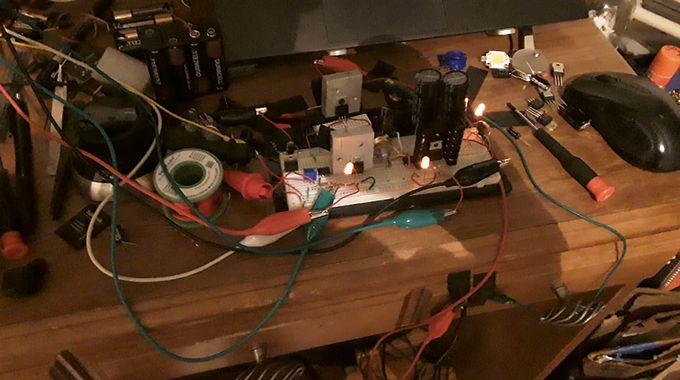
I developed the two core systems independently, starting with the magnetic levitation circuit to ensure I could achieve sufficient lifting capacity. I designed an analog control loop utilizing 741 operational amplifiers. A Hall effect sensor, mounted to an initial prototyping enclosure, measured the magnetic flux and fed real-time data back to the op-amp circuit. This feedback loop drove a high-power MOSFET, which regulated the heavy current flowing into a large, pre-built inductor. A robust power supply was necessary to guarantee the inductor generated enough magnetic force to continuously suspend the mass.

Wireless Power Transfer Circuit:
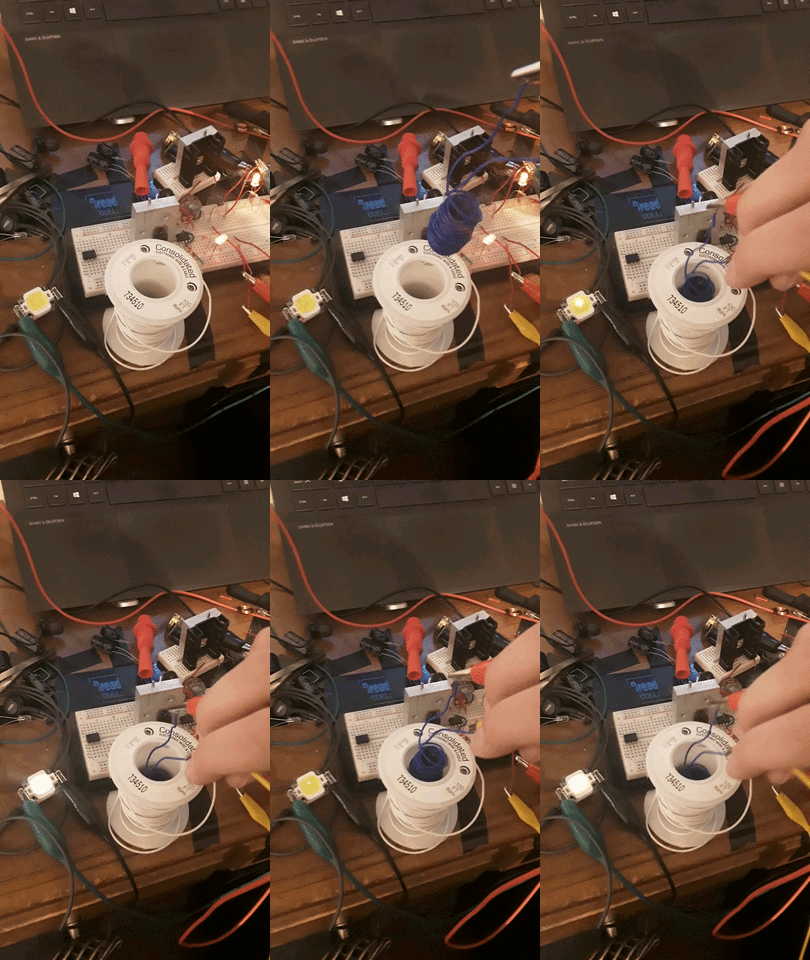
After stabilizing the levitation system, I focused on wireless power transmission. I utilized a 555 timer configured in astable mode to generate the necessary high-frequency oscillation. For the power transfer, I hand-wound custom transmitter and receiver coils. The floating LED assembly housed the receiver coil along with a capacitor and a diode, acting as a rectifier and low-pass filter to provide stable DC power to the LED. Once this standalone circuit was functioning reliably, I integrated the custom transmitter coil directly beneath the levitation inductor.
Final Design:
Integrating both systems presented a significant engineering challenge: electromagnetic interference (EMI). The strong magnetic field generated by the levitation circuit introduced severe noise that directly interfered with the wireless power transmission. To resolve this, I implemented custom low-pass filters for both circuits and carefully tuned their operating frequencies to isolate them. This frequency separation successfully mitigated the cross-talk, resulting in a stable, wirelessly powered, levitating light bulb.